Thurston Community College's Visit to Belfast
School / Group
Thurston Community College
Teacher / Group Leader
Neal Watkin (case study provided by Jean Wheeler, EVC)
Destinations(s)
Subjects(s)


What was your main objective for this trip?
The Level 3 Politics qualification gave the basis for the aims and objectives to cover in relation to 'curriculum' and 'optional topic' being studied by the students. But this visit was about so much more than 'topic' and 'curriculum'. However, these bases were covered both within the planning and itinerary of this visit in discussion with the Halsbury team who accommodated all our requests for this visit.
The accepted and documented aims and objectives for the visit were linked directly to the 'curriculum' being studied and, as such, the visits focused on the following: the development of knowledge and an informed understanding of contemporary political structures and issues in their historical context; an awareness of the changing nature of politics; and an understanding of the influences and interests which have an impact on decisions in government and politics. With this knowledge, the students are in a position to go on to develop the ability to critically analyse, interpret and evaluate political information to form their own arguments and make their own judgements.
The 'topic' focus for the visit was linked directly to the optional unit being studied from the specification, that of Nationalism. This optional unit develops the students' understanding of nationalism, as the belief that people have been attached to different practices connected with their heritage. The students learn about the different types of nationalism, including internationalism, with the core principle being that the world should unite across boundaries to advance their common interests in society. Students study the idea that some forms of nationalism also have an internationalist perspective, whereas other internationalists reject nationalism.
Why did you choose this destination?
The destination, linked so closely to the curriculum and topic, the aim was to support the further development of their understanding, interest in and engagement with contemporary politics. But it resulted in so much more than this, so much more.
At Thurston Community College, the Level 3 politics lessons are run as if they are a UK Cabinet meeting. Each student runs a department and they set an agenda for meetings. The Cabinet decided that one of their priorities was to organise a visit. After investigating different options, the group found out that it was possible to visit the Parliament of Northern Ireland and not only meet and interview existing members of the assembly, but also to witness a committee session from the gallery. That was the genesis of the idea for the visit, with the students making the decisions on where to go and what to do; driven by their own interests, passions and desires for first-hand knowledge and understanding of real-life politics.
From a seed of a suggestion, then was added into the itinerary two walking tours to better understand the history of the city and its place in Northern Ireland, and to enhance the students' knowledge of the 'Devolution' section of the course. Also, to gain a wider understanding of the evolution of the Republic of Ireland, Northern Ireland and the political landscapes of both. The Visit Leader then asked Halsbury, who we had previously worked with, to organise something that fitted with our requirements - and they did just that.
We anticipated the learning objectives would be met for the students participating in the visit as the visit was robustly planned and organised by Halsbury with an itinerary to support learning for Level 3 politics; little did we realise the learning that would come from this visit by so many other individuals within our own community at the college but also the wider community of our vast rural catchment area. And that learning continues to this day.
Can you briefly describe the visits and activities you participated in during this trip?
The two days involved time both for the 'informal group activities' and the 'formal group activities'; both were scheduled into the itinerary for the visit.
There was time to stroll past the bars, cafes and trendy restaurants that line the streets of Belfast. Time to walk down the Falls Road. Time to visit Stormont and to question a member of the Northern Ireland Assembly before witnessing a live committee meeting. Time to tour Belfast City Hall and its exhibitions. Time to visit the magnificent building which is the Titanic Museum, which emerges from the dockland area. Time for a walking tour of the city centre with a survivor of the difficult period, which is integral to the history of Belfast, with the tour ending in a walk along the Peace Wall. Time to sip a coffee in Starbucks, buy a pie in Greggs, go into Zara to look at party outfits, and time to shop for a souvenir as a reminder of this incredible visit.
This visit was 'monumental' on every level. Monumental for those involved in planning, organising, leading, participating in and evaluating the visit. Monumental for those reading about the visit on the College social media platforms and in the local village magazines. And monumental for those who sought to ask with interest about every minute detail of what happened on this remarkable visit.
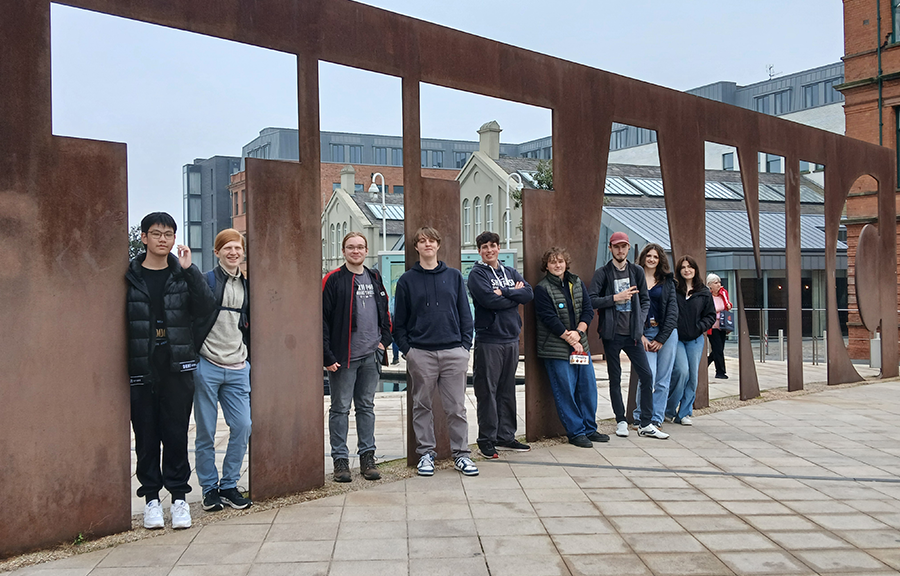
Starting with day 1:
The first stop was the new Titanic Museum - a magnificent building that emerges from the dockland area, just as the actual ship did in 1912. It's an impressive place and serves to anchor the history of Belfast in a wider context that stretches back beyond 'The Troubles'. It is obvious that Belfast wants to show visitors that it was once an industrial powerhouse and that the bombings and paramilitaries were an interval in the longer story.
Next was a walking tour of the city centre with a survivor of that difficult period. Jim was able to peel back the layers of the city for the students and show them what it was like to be a teenager like them in the late 1960s and 1970s while constantly having to worry about where they were and who they were with.
Particularly moving was the story of a man who still returns every day to sit across from the bar where his brother was brutally murdered. Every street in the city centre has a similar story to tell, and it was a sobering reminder of what the city had to live through.
Continuing on to day 2:
This started with taking a local bus to Stormont. The students were able to question a member of the Northern Ireland Assembly before witnessing a live committee meeting. Both gave valuable insight into how this region of the UK is having to deal with its past while trying to move forward. There is a carefulness in their approach that ensures justice is seen to be done for all communities; while the old divisions are always there in the language, it somehow feels inclusive, and there is a determination not to leave anyone behind.
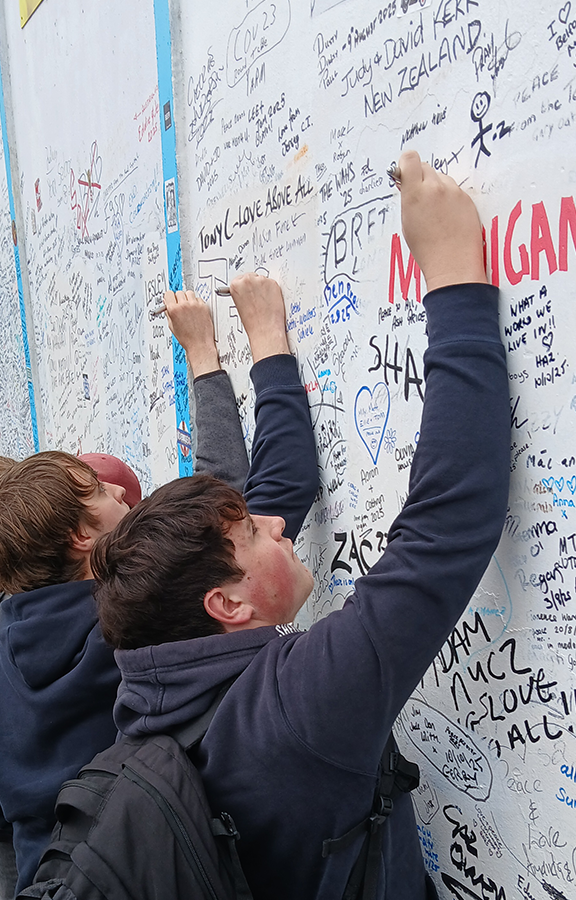
The visit ended with a walk along the Peace Wall. Here, people from around the world have left messages of hope. You cannot help but be moved by the scene. As we stood on the Falls Road waiting for the bus to take us back to the city centre, we reflected on the changes around us. Gone are the burning tyres, soldiers and individuals with faces hidden by black balaclavas. The rubble and broken windows have been replaced by pavement cafes and shoppers of all faiths. This is an incredible testament to the desire of a city to reinvent itself.
Belfast's ambitions are not lofty - it doesn't aim to be a metropolis of modernity; it just wants to be normal. And here, normality is more beautiful than a Parisian boulevard or a Venetian canal. Having held its breath for decades, it now collectively exhales. You can hear it quietly echoing around Belfast's streets, and it is such a wonderful sound. And the people of Belfast love this. It feels good to be normal, to be ordinary, to be free of the troubles that plagued the city from the 1960s to the early 2000s.
As a member of the public relayed on our return, this is like a ripple in water with the impact spread far beyond the participating students. The visit had an impact upon the families, friends, the participating staff, the College community via its social media platforms, and the Wider Community of our neighbours in the surrounding towns, villages and farms.
What will be your lasting memories of this visit?
The Visit Leader said the following:
Belfast city centre wears its past lightly. There are no blue plaques to the key figures of the conflict, no memorials at the sites of the atrocities, no information boards that remind residents of how it used to be. This is a place with its eyes firmly fixed on the future. You cannot see the recent past, but if you take the time and are patient, you can hear it in the voices of the people who say "it's good to see you here now".
One student said the following:
When I visit new places, I look at the graffiti on the streets. For me, graffiti represents the subconscious of a place: thoughts, ideologies, collective psyche, what people feel they need to express through symbolism. The streets of Belfast are akin to most UK cities, with the usual tags, scrawlings and political posters. But on lampposts and walls, the Troubles-era divisions spill onto the public concrete. But just writing that would be a mischaracterisation of what I saw in Belfast. While on the local bus, our teacher and I had a brief conversation with another passenger, a local, about the graffiti that is easy to see. The passenger talked about how some of the Troubles-era local figures he knew had reinvented themselves and found a way to live in peace and that the graffiti was a 'legacy from the past' rather than 'a representation of the here and now'.
Another student said the following:
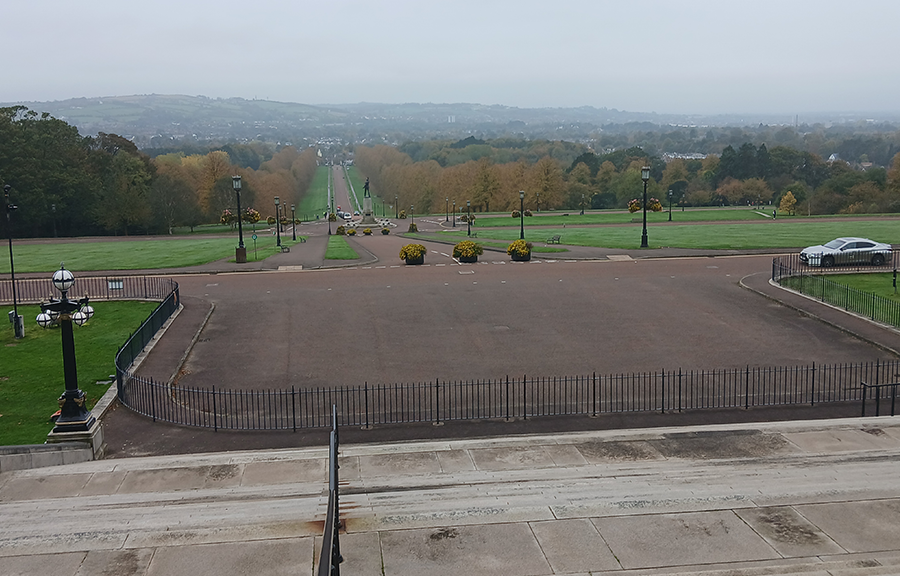
I spoke with a person in Greggs whilst in the queue, and he said (to paraphrase), whatever the arguments of the Stormont in reality, when a debate was concluded, politicians of all sides were friends. In England, this would probably be an expression of political apathy and distrust of politicians, but for Northern Ireland this was an expression of wary hope in consocial (cross-community) politics, a sentiment echoed by all the local people I spoke to. While in Stormont's central lobby, members of the Irish Assembly milled around after a debate about a prospective budget. It did not feel like a society on the edge of members of opposing parties, as they intermingled and rushed to the toilet in unison. Stormont itself, with its elevated position over a small valley, felt like an expression of both the political and social historic journey of Belfast, with the long walk up the slope feeling symbolic of the long process of trust-building that had resulted in Northern Ireland's Assembly.
And another commented:
I was well out of my comfort zone for a number of personal reasons. One highlight was travelling by bus around Belfast; it was full of people from any number of religious backgrounds and nationalities. It contrasted with the history of Belfast we heard about on the walking tour. No divisions on the bus. Seeing the Covenant in the amazing Belfast City Hall was impressive. There were few obvious signs of the Troubles, although the police cars are heavily armoured compared to rural Suffolk! My grandparents were keen to hear everything about the visit; they remember Belfast being on the news every night when they were teenagers. When we got back to school, one of my friends who was not on the visit sayd "wouldn't it be good if everyone could just be friends and if they can't be friends then just be civil to each other?" I agree!


Why did you choose Halsbury for this visit?
Prior experience of superb planning and organisation and adapting itineraries to fit the College's needs, desires and budget.
Were there any extra benefits that Halsbury offered to support you with this visit?
The expert knowledge of destinations, on-the-ground contacts, and total adaptation to the Visit Leader and students' needs and wishes.
How would you describe the experience of working with Halsbury on this visit?
Superb and definitely will become an annual visit for our Level 3 Politics students. The visit also attracted our Level 3 History students and...I can say now that staff and students alike, irrespective of subjects taught/studied, are clambering to participate in the next visit to Belfast.
Would you recommend Halsbury to your friends and colleagues?
Yes 100% - for all the reasons outlined in this document and more besides!

