

Italian students can listen, speak, read and respond in real settings. Art students can meet the Renaissance face-to-face. Maths students can see proportion, perspective, geometry, measurement and invention built into the skyline.
Florence works brilliantly for Italian, art and maths because its medieval centre, cathedral, galleries, piazzas and Renaissance architecture sit so close together (which helps when you're managing timings, headcounts, tired feet and a full itinerary). Classic museums, a stunning cathedral and some of the world's most remarkable architecture are all set to be discovered in Florence.
Florence does more than just inspire. It supports your scheme of work, keeps students engaged and (importantly) feels really manageable for staff.
Italian
For Italian students, Florence gives language learning urgency. They're not just rehearsing phrases, they're actually using them to introduce themselves, describe places and things, ask questions and express opinions. They're using them to order food, navigate the city and respond to everyday interactions.
At Key Stage 3, a school trip to Florence supports practical communication (including listening, speaking, reading and writing). Your trip will help students continue to build competence in this, as well as encourage students to understand and communicate personal and factual information, develop opinions and use language with increasing confidence.
At GCSE, Florence supports common themes including food and drink, daily life, free time, customs, celebrations, home and neighbourhood, travel and tourism, and Italian culture and identity. Your trip will help students communicate with native speakers in speech and writing, broaden their horizons and develop awareness of the culture and identity of Italy.
At A-Level, Florence opens up rich opportunities for deeper cultural study. Students can explore aspects of Italian society, music and media, festivals and customs, cultural heritage, immigration, diversity and individual research projects. A visit gives students real context for discussions about identity, place, heritage and contemporary Italian life.
Curriculum Relevance
- Key Stage 3:
- Exploring the town
- Hobbies and pastimes
- Food and drink
- Eating out
- Introducing yourself
- Describing others
- Likes and dislikes
- Plants and animals
- Cultural traditions
- GCSE:
- Food, drink and eating out
- Daily life and free time activities
- Customs, celebrations and festivals
- Home, town and neighbourhood
- Travel and tourism
- Understanding Italian culture and identity
- A-Level:
- Aspects of Italian society
- Music and media
- Cultural heritage: festivals and customs
- Immigration and cultural diversity
- Individual research opportunities
Key Sites:
- Explore Florence City Centre - The streets, squares, cafes, markets and bridges of Florence give students the chance to practise Italian in context. They can use transactional language, read public information, listen for key words and build confidence with authentic communication.
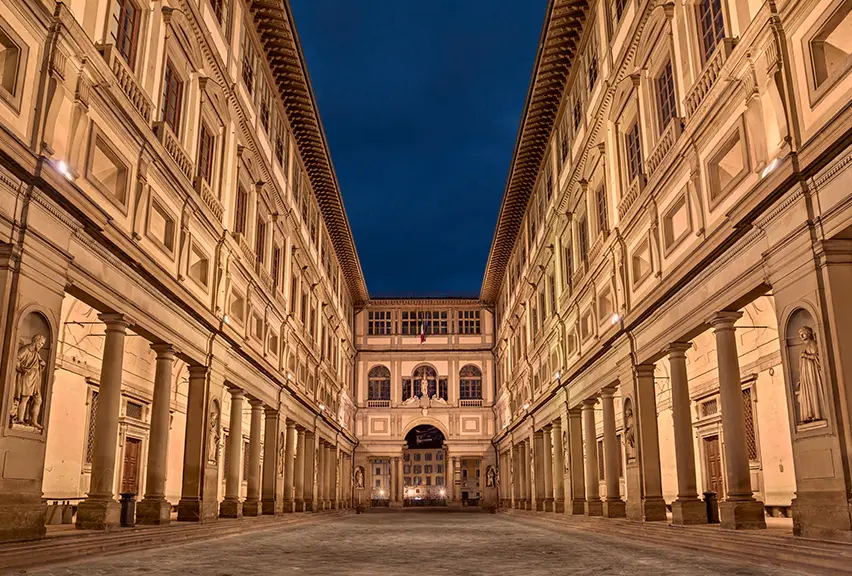
- Uffizi Gallery - The Uffizi gives language students a natural setting for opinion language, description and cultural vocabulary. Students can describe works, compare styles and discuss what they liked (or didn't like) using real cultural content. The Uffizi's collections include major 14th-century and Renaissance works by artists such as Giotto, Botticelli, Leonardo da Vinci, Raphael, Michelangelo and Caravaggio.
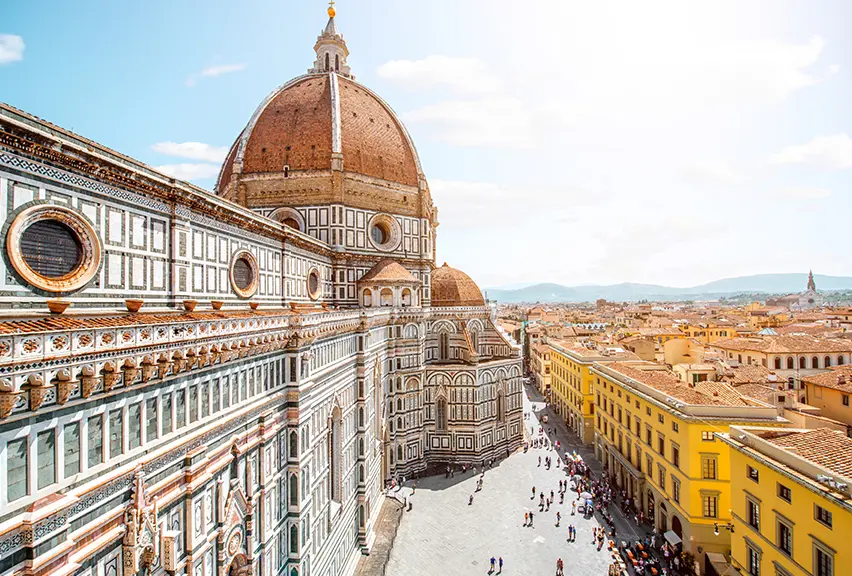
- Florence Cathedral, Belltower and St.John's Baptistry - The Duomo complex gives students a powerful introduction to Florence's religious, artistic and civic identity.
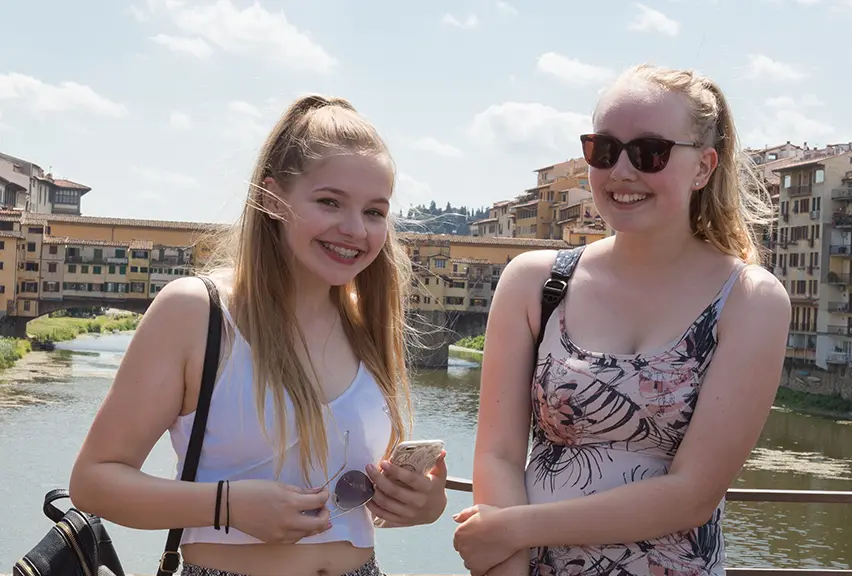
- Ponte Vecchio - This famous bridge is ideal for place vocabulary, directions, shopping language and discussion of local identity. Students can practise describing what they see, asking and answering questions, and comparing Florence with their own town.
- The Boboli Gardens - The Boboli Gardens offer useful vocabulary around nature, description, history and leisure. The gardens sit behind the Pitti Palace and feature sculptures, grottoes and fountains.
- Race for Time - This self-led activity trail gives students a structured way to explore the city while working together, following clues and engaging with their surroundings (and using their Italian, of course).
Learning Outcomes:
By the end of an Italian language trip, students should be able to:
- Use Italian more confidently in practical, real-world situations.
- Listen and respond to spoken Italian outside the classroom.
- Read signs, menus, information boards and public notices with greater independence.
- Apply grammar and vocabulary to authentic contexts.
- Develop cultural understanding of Florence and wider Italian identity.
- Build confidence for GCSE speaking and writing tasks.
- Gather first-hand insight for A-Level discussion, research and cultural analysis.
Art
Florence is one of the strongest destinations in Europe for an art school trip because the city places students at the heart of Renaissance art, architecture, sculpture and patronage. It helps them see how artists respond to belief, power, place, technique and materials.
At Key Stage 3, Florence supports evaluation and analysis of creative works, the study of great artists, craft makers and designers, and the effects of historical and cultural contexts. Your students will be encouraged to develop as critical and reflective thinkers, build understanding of art in historical and contemporary contexts, and use sources to inform creative intentions.
At GCSE, Florence links directly to museum, gallery and site visits, personal responses, key artists and craftspeople, and the study of contemporary and historical contexts. Your students will be encouraged to develop as critical and reflective thinkers, build understanding of art in historical and contemporary contexts, and use sources to inform creative intentions.
At A-Level, Florence gives students the depth they need for independent judgement and personal investigation. They can explore artist influence, continuity and change, genre, style, meaning, artefacts, social context, cultural context and portfolio development.
Curriculum Relevance:
- Key Stage 3:
- Evaluation and analysis of creative works
- Works of great artists, craft makers and designers
- Effects of historical and cultural contexts
- GCSE:
- Responses to museum, gallery and site visits
- Personal reflections on art
- Works of key artists, craftspeople and designers
- Contemporary and historical contexts of art
- A-Level:
- Impact and influences of various artists
- Continuity and change in different genres and styles
- Independent judgements of art
- Conveying meaning through images and artefacts
- Social and cultural context of images and artefacts
- Personal portfolio: reflections, resources and influences
Key Sites:
- Galleria dell'Accademia - A visit to the Galleria dell'Accademia gives students the chance to study Michelangelo's David and other works in close detail.
- Palazzo Pitti - Palazzo Pitti helps students explore collecting, patronage, power and display. It's also a strong site for discussing how art sits within architecture and social history.
- The Boboli Gardens - The Boboli Gardens are valuable for students interested in sculpture, landscape design, perspective, movement and the relationship between nature and art. Their formal layout, statues, grottoes and fountains make them a brilliant outdoor sketchbook setting.
- The Gallery of Modern Art - This gives students a useful counterpoint to Renaissance Florence. They can compare periods, styles, materials and artistic intentions.
- Uffizi Gallery - A visit to the Uffizi Gallery is essential for students studying Renaissance art, composition, symbolism, narrative and technique. Its collections include works by Botticelli, Leonardo da Vinci, Michelangelo, Raphael and Caravaggio, giving students a concentrated route through some of the most influential names in Western art.
- Florence Cathedral - The Duomo is a masterclass in architecture, scale, design and visual impact. Students can explore façade, form, decoration, sacred space and engineering ambition in one unforgettable site. The cathedral complex includes the cathedral, dome, bell tower, baptistery and the Opera del Duomo Museum.
Learning Outcomes:
By the end of the trip, students should be able to:
- Analyse major works of art in context.
- Record first-hand observations through drawing, photography, annotation and written reflection.
- Use specialist vocabulary more confidently.
- Understand how historical, religious, social and cultural contexts shape art.
- Compare different artists, periods, styles and techniques.
- Explore how materials, scale and setting affect meaning.
- Develop ideas for GCSE coursework or A-Level personal investigation.
- Return with stronger sketchbook evidence and richer visual research.
Maths
Florence helps students see that maths isn't just something that happens on a worksheet. It shapes buildings, solves problems and drives invention.
Your trip will help students to see maths as an interconnected subject and will highlight the importance of applying mathematical knowledge to science and other subjects.
Florence supports learning in STEM by showing maths in action through art, architecture, science and engineering.
Curriculum Relevance:
- Supports learning in STEM
- Applications of mathematical thinking
- Maths-based careers
- Using maths to solve problems
- The Golden Ratio and Fibonacci
- The history of number systems
- Maths in action - art and architecture
Key Sites:
- Leonardo da Vinci Museum - This museum helps students connect maths, design, invention and engineering, as well as offering insights into Leonardo's masterpieces and inventions.
- Museo Galileo (Institute and Museum of the History of Science) - The Museo Galileo is one of Florence's strongest visits for STEM learning. Its instrument collection is among the most important in the world, preserving evidence of scientific research promoted by the Medici dynasty.
- The Garden of Archimedes - The Garden of Archimedes is a museum dedicated to mathematics, with sections designed to help visitors discover maths in different ways. Interactive exhibits include "Beyond Compasses: the Geometry of Curves", which reveals the mathematics hidden within everyday objects.
- Florence Cathedral - Brunelleschi's dome gives students a vivid example of maths, engineering, measurement and problem-solving, as well as the importance of mathematics in Renaissance Florence.
- Ponte Vecchio and the City Skyline - The bridge, rooftops, streets and towers of Florence are ideal for practical discussion of shape, structure, symmetry, perspective, angles and scale. Students can sketch, estimate, compare and question.
Learning Outcomes:
By the end of the trip, students should be able to:
- Recognise mathematical thinking in architecture, science, engineering and design.
- Make connections between maths and STEM careers.
- Apply problem-solving skills to real-world examples.
- Understand how geometry, proportion and measurement shape the built environment.
- Explore the history of scientific and mathematical instruments.
- See links between maths, art and architecture.
- Build confidence by seeing maths as creative, practical and powerful.
Why Choose Florence for a School Trip?
Florence is a superb choice for a school trip because it gives teachers depth without unnecessary sprawl. The city is compact, walkable and rich in curriculum value. And that's really important when you're moving a group through busy streets, managing timings, checking everyone has eaten and trying to preserve enough energy for your afternoon visits.
For Italian students, Florence creates language moments around every corner. For art students, it offers world-class galleries and extraordinary public architecture. For maths students, it makes abstract ideas visible through structures, instruments and design.
And there's huge scope for a cross-curricular trip. You could build a trip around Italian and art, art and maths, or a broader Renaissance study programme. Students can investigate how language, science, politics, religion, architecture and creativity shaped one another in a city that changed Europe.
Next Steps: Start Planning Your Visit to Florence
Start by choosing the learning focus for your trip. Do you want to build your students' confidence in Italian? Inspire stronger sketchbook responses? Show maths in action? Or bring several departments together for a cross-curricular trip to Italy?
Once you know the purpose, Halsbury can help shape the practical plan. Enquire today and share your dates, group size, budget, preferred subject focus and must-see visits, and we'll design the trip around your students.
We know what teachers are balancing. Cover. Consent forms. Risk assessment. Budgets. Parent questions. The need for the trip to be both inspiring and watertight. That's why we're here to guide, support and deal with the details.
Tell us what your students need from Florence, and we'll help you build a trip that feels purposeful, practical and packed with learning.


