

A school trip starts long before a coach pulls away from the gates. It starts with an idea and the conviction of a teacher who believes that exploring their subject out in the 'real world' is an experience their students should have access to.
Then come the quotes, approvals, risk assessments, parent questions, payments, passport details, medical information, staffing and cover. That's alongside all the marking, lesson planning and meetings that a full-time teacher is expected to do (and let's not forget the important part - the actual teaching).
We wanted to understand that reality a little more clearly, so that we could provide the help teachers really need. So, we asked 94 customers about the work behind school trips (as well as why they keep running them, what makes the process harder, and what practical support would make the greatest difference).
Here's what they told us.
Why Teachers Continue to Invest in School Trips
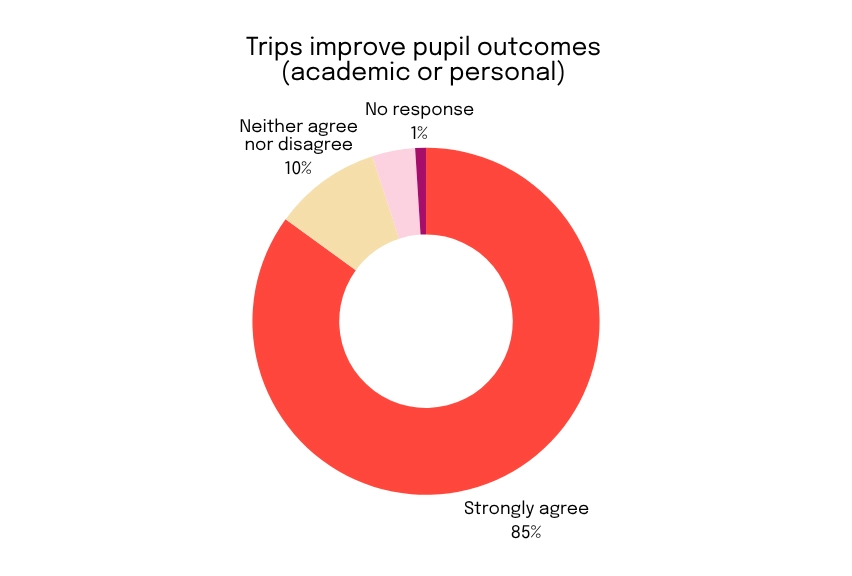
The commitment to school trips is clear. 85% of respondents to our customer survey agree that trips improve pupil outcomes (both academic and personal). And 78% see trips as a core part of their school's educational offer.
The lead motivations are equally telling. 70% said they run trips to build pupils' confidence and resilience. 67% said they want to build cultural capital and widen horizons. And half want to bring the curriculum to life.
This is the real heart of the story. Teachers keep doing the work because they see what happens when a young person encounters a new place, new language, new challenge or new sense of possibility.
The Hidden Workload
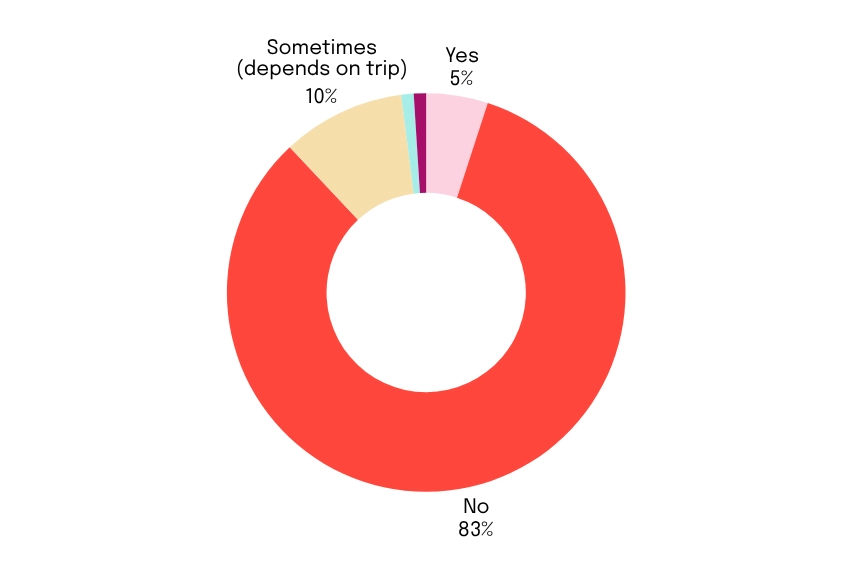
But despite the value teachers see in school trips, 83% of respondents told us they receive no formal time during the working day to plan them.
We asked: In your school, are trip leaders given any formal time allowance during the working day to plan a trip?
That becomes even more concerning when you consider how long it takes to plan a trip. 50% of respondents told us they spend at least 21 hours planning a typical trip. And 32% said they spend more than 40 hours planning (that's effectively a full working week on top of their already full-time job).
Risk assessments and paperwork take the most time, according to 70% of survey respondents, followed by parent communications (59%). 47% of respondents identified getting and comparing quotes, collecting payments and collecting travel documentation among the tasks that take up most of their time.
One respondent summed it up pretty plainly: "The admin - chasing parents, etc. - is untenable in an already full-time job".
And things aren't improving. In fact, 73% of respondents say that planning trips is getting harder each year.
The Affordability Challenge
Parent affordability was rated extremely challenging by 74% of respondents. And 81% agreed that the cost-of-living pressure on families affects trips a lot.
And this (of course) affects participation. 69% identified pupils from socially disadvantaged backgrounds beyond existing financial support as the group most at risk of missing out on school trips (with a further 57% selecting pupils eligible for support such as Pupil Premium).
Teachers' comments show that affordability isn't only about the final total. It's also about the timetable (e.g. when deposits are due, how quickly a family must find a large amount, whether a place can be held and how transparently optional costs are explained).
That gives the school travel sector practical work to do, including making prices and options as clear as possible, providing more flexible options and payment plans that reflect family budgets and school processes.
We have seen the cost of school trips rise over the last three years (although the median price per pupil rose by less than 2% on average last year, which is why we use our expertise to help group leaders find more cost-effective ways to run their trips.
For example, we always advise booking trips as far in advance as possible (our average enquiry-to-trip-departure time is 364 days, rising to 432 for ski trips) is the best way to keep costs down. This usually means you'll benefit from the lowest prices (because availability for accommodation and transport is better) and you'll be giving parents a longer time period over which to spread trip payments.
We can also advise on cheaper times to travel, other accommodation options you could consider, the most cost-effective transport options, and activities and visits that are cheaper (or even free) that would support your learning objectives just as well as the more costly options.
Securing the Future for Educational Visits
When we asked what would make respondents more likely to use a tour operator than plan independently, reduced admin came first, selected by 68%. Better value for money followed at 44%, with reduced staff workload in third at 38%.
According to the survey, the practical resources teachers value most are an approval pack with policy-aligned documents and risk assessment templates (55%), payment plans and affordability support (54%), a parent communications pack (46%) and 24/7 support during the trip.
There's a clear brief here for school tour operators:
- Make the trip easier to approve.
- Make the price easier to understand.
- Make information easier to collect.
- Make documents easier to find.
- Provide teachers with comprehensive support when plans change.
Clearly, that won't remove every pressure (school staffing, timetable decisions and internal governance sit beyond any operator's control). But tour operators can remove repetition, reduce uncertainty and design services around the working reality of teachers.
School Trips Remain Resilient
Or perhaps we should say that teachers remain resilient. 76% of respondents said that their school is either likely or extremely likely to run a UK residential in the next 12 months. 66% say the same for an overseas educational trip. And most expect their school's overall trip programme to stay broadly stable.
That resilience really matters. Teachers still want students to encounter the wider world, and students still need those opportunities. As a school tour operator, our job is to listen to teachers, learn and solve the practical problems that stand between a good idea and a coach full of young people ready to learn outside the classroom.
We've certainly seen the demand for school trips remain pretty stable over the last couple of years, and the mix of trips being booked has been stable too. So, despite the challenges, young people are still benefiting from these transformative experiences, thanks to the dedication of their teachers. Our job is to find new ways to support you with this, so it doesn't take up so much of your time and energy.
Our top four destinations (France, Belgium, Spain and Italy) have also remained so throughout the last three academic years, collectively accounting for around two-thirds (67%) of bookings over the past three school years.
| 23/24 | 24/25 | 25/26 | Three-year share | |
| France | 11% | 15% | 26% | 19% |
| Belgium | 15% | 15% | 10% | 13% |
| Spain | 10% | 10% | 17% | 13% |
| Italy | 24% | 29% | 17% | 22% |
| Combined | 60% | 70% | 70% | 67% |
What Happens Next?
We'll be using the findings of this survey to explore where we can make the planning process easier for teachers, from clearer quote options and approval-ready information to better support with parent communications and passenger data collection.
We'll keep testing those ideas with teachers, and we'll discuss them with our Halsbury Education Community (a forum of experienced group leaders who meet regularly to discuss the issues facing schools and teachers and help us understand how we can help).
And you may have seen that we've recently launched My Trip Zone, our bespoke customer portal. Early feedback from teachers who have used it for their trip has been hugely positive, and we believe it will significantly reduce one of the biggest admin tasks for teachers - passenger data collection (find out how on our My Trip Zone page).
A note on the methodology: the survey is a customer/contact survey and isn't nationally representative. Percentages are rounded, and some questions allowed multiple responses.