

You need enough structure to keep the trip smooth, but enough real-life French to make the experience feel alive. You need culture, conversation, good logistics, and a little Mediterranean magic.
That's why Sète, in the South of France, is such a strong choice.
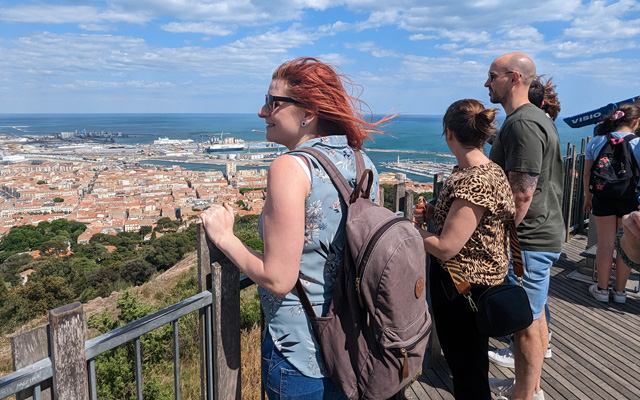
Set between the Mediterranean Sea and the Étang de Thau lagoon, Sète offers beaches, canals, markets, street art, seafood traditions and a proudly local culture. It's smaller and easier to navigate than many larger French cities, which makes it brilliant for school groups. But it still gives students that wonderful feeling of being properly immersed in French life.
And for language learners, that matters.
In Sète, students can practise French in lessons, with host families, at the market, on guided visits and during everyday encounters. Ordering lunch. Asking questions. Reading signs. Listening to local accents.
Why Choose Sète?
Sète is one of the best destinations if you're looking for a French trip with a strong cultural focus.
It offers:
- French lessons at a specialist language school.
- Host family or residence accommodation.
- A relaxed, friendly environment for speaking practice.
- Easy access to Montpellier.
- Beaches, canals and a compact city centre.
- Authentic local culture (including water jousting, seafood, street art and music).
- Strong options for GCSE and A-Level French groups.
For teachers, Sète also has one huge advantage: it feels manageable.
Students can experience the confidence-boosting thrill of using French in real situations, without the intensity of a huge city. The pace is calmer, the centre is walkable. The atmosphere is warm. And that gives students the space to try, stumble, smile and try again.
And that's where the real learning happens.
Example 5-Day Itinerary in the South of France
This sample itinerary is designed for a school group staying in Sète and combining French lessons with cultural activities. Your exact itinerary can be tailored around your group size, age range, learning objectives, flights and accommodation preferences.
Day 1 - Travel to Montpellier and Transfer to Sète
- Flight to Montpellier
- Transfer from Montpellier to Sète
- Transfer to your accommodation
- Possible free time for local familiarisation on foot
- Evening meal at your accommodation
Your group will fly from the UK to the South of France. The nearest airport to Sète is Montpellier, although other airports may be possible depending on your departure point and flight availability.
On arrival, you'll transfer by coach to Sète. The journey from Montpellier to Sète usually takes around 40 minutes (making this a smooth and sensible arrival route for school groups).
Once you arrive in Sète, your group will transfer to your accommodation and settle in.
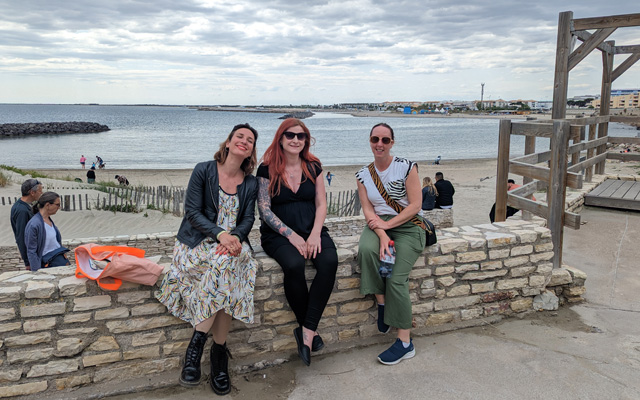
Depending on arrival time, you may have the chance to explore the local area on foot. This can work well as a gentle first activity: students can spot signs in French, get their bearings and begin adjusting to the rhythm of the town.
You can usually choose between two main accommodation styles: host family or on-site residence accommodation.
Host family accommodation is ideal for groups who want the fullest language immersion experience. Students usually stay in pairs and have regular opportunities to practice French in a natural setting (particularly during evening meals).
Host families are carefully selected by the language school and are used to welcoming school groups (so they all have clean police records and live within half an hour of the school by public transport or on foot). For many students, this becomes one of the most memorable parts of the trip. It's where classroom vocabulary becomes real conversation.
On-site residence accommodation makes more sense for groups who want to stay together. You'll stay at the school's beach campus, which offers classrooms, dining facilities and outdoor space, all within easy access of the beach.
This can work particularly well for younger groups, first-time travellers or teachers who prefer a more contained base.
Day 2 - French Lessons and Discovering Sète
- Breakfast at your accommodation
- French lessons at a specialist language school
- Free time for lunch
- Guided walking tour of Sète
- Pétanque workshop
- Evening meal at your accommodation
Your first full day in Sète begins with breakfast, followed by French lessons at a specialist language school.
Lingua Sète is dedicated to providing French lessons to closed groups, such as school groups. That means that everything can be tailor-made to suit each group’s requirements, from the content of lessons to the focus of activities. And there are two locations to choose from – the city centre campus and the beach campus. We started day two with a tour of the city centre campus.
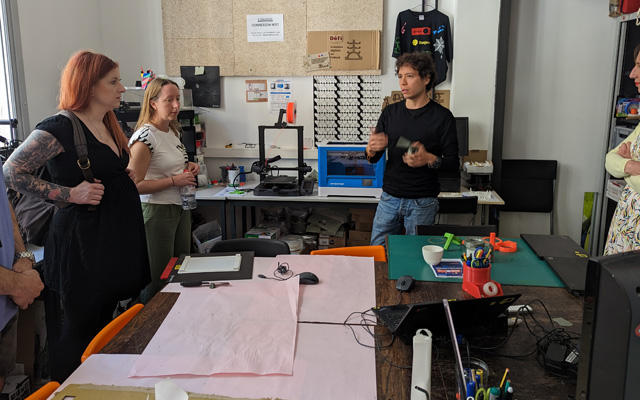
The city centre campus is just a few steps from the Canal Royal. Lessons take place in La Palanquée – a community hub described in sociological terms as a ‘third place’. This space is provided as an anchor to community life and as a place designed to facilitate creative interaction, making it a really exciting place for students to take their French lessons.
The building is bright, modern and spacious, and the classrooms are fully equipped for French language lessons. There is also an on-site café where you can get delicious drinks, snacks and even lunch. When you’re not in lessons, your students could have the opportunity to interact with the locals who come here to collaborate on creative initiatives and develop prototypes of products in the incredible FabLab.
FabLabs exist as a library of equipment that allows people to create prototypes of products, and include 3D printers, software, woodcutting and textile equipment. They provide the local community the opportunity to learn new skills and to create and invent while being mentored by experts. The exciting thing for our groups is that by having lessons in the La Palanquée, it could be possible to arrange for your students to enjoy a workshop with a FabLab expert to create a souvenir of their trip to Sète.
The city centre campus would be a fantastic option for older groups (GCSE and A-Level) who want to combine their French lessons with the opportunity to explore this creative community hub and interact with the locals using it. Your students will have no choice but to be inspired by this experience!
Lingua Sète also offers a beach campus that would be ideal for younger groups or groups who want to make the most of Sète’s incredible setting on the Mediterranean coast.
This centre has been purpose-built to accommodate groups, and so there’s a great variety of accommodation options, as well as fully-equipped classrooms, and a large dining room that can easily accommodate even the largest group. There's also a lovely hall which would be ideal for an end-of-trip disco, as well as plenty of outdoor areas for students to stretch their legs or kick a ball around.
Secure access to the beach is through a gated tunnel (so your group won’t even need to cross any roads to access it). The beach offers plenty of space for groups to relax or even play some beach games while being small enough to make supervision easy. In the summer months, there's a lifeguard station on the beach, as well as toilets. There are also shops nearby that sell snacks, as well as a larger beach just a short walk along the corniche if you do want a little more space.
Lessons will be tailored to your group's level and learning objectives, which is incredibly useful for teachers preparing students for GCSE, A-Level or general confidence-building. You can focus on speaking practice, listening skills, cultural themes, topic vocabulary or language needed for the rest of the trip.
When students learn language in the morning and then use it in the afternoon, the trip becomes so much more than sightseeing. It becomes active, applied learning.
If your group is based at the school's city centre campus (which will be the case if you're staying with host families), then Les Halles makes a brilliant lunch stop.
This covered market is packed with local produce, regional flavours and the sounds of everyday French life. Students can practise simple transactional French, listen to local conversations and see how food connects to identity.
Encourage them to look out for tielle, one of Sète's best-known specialities. This savoury pie (often made with octopus and tomato) reflects the city's strong maritime heritage and Italian influences.
Fun fact: Sète is sometimes called the "Venice of the Languedoc" because of its canals. But it has a character all of its own. More fishing boats than gondolas (and more tielle than tiramisù).
In the afternoon, you'll enjoy a guided walking tour of Sète
This is the perfect way to introduce students to the city's story. Sète is a working port, a seaside town, a cultural hub and a proud local community all at once. Its canals link the Étang de Thau lagoon with the Mediterranean, while Mont Saint-Clair rises above the town and offers sweeping views across the coast.
Key places your group will discover include:
The Canal Royal
One of Sète's most recognisable landmarks and the setting for the city's famous water jousting events.
La Pointe Courte
A traditional fishing quarter with colourful houses, narrow lanes, nets, boats and a strong local identity. It gives students a real sense of Sète's maritime roots.
Mont Saint-Clair
The hill that overlooks the town, lagoon and sea. The view helps students understand the geography of Sète beautifully: water on both sides, with the town tucked between the lagoon and the Mediterranean.
An open-air theatre overlooking the sea, used for concerts and cultural events.
The Marine Cemetery
The resting place of poet Paul Valéry, one of Sète's most famous figures.
You'll then round off the day with a pétanque workshop.
It's relaxed, sociable and wonderfully French. It also works brilliantly for groups because everyone can have a go. Students can learn the rules, practise key phrases and enjoy a little friendly competition.
After a full day of lessons and exploring, you'll return to your accommodation for dinner.
If students are staying with host families, this is another valuable opportunity for real conversation (encourage them to prepare a few questions in advance, so they feel a bit more confident).
Day 3 - French Lessons and Excursion to Montpellier
- Breakfast at your accommodation
- French lessons at a specialist language school
- Free time for lunch
- Guided excursion to Montpellier
- Evening meal at your accommodation
Day 3 begins with breakfast and another morning of French lessons.
By this point, students are usually starting to settle into the experience. They've heard more French. They've used more French. They've realised they don't need to understand every single word to communicate.
That's a powerful moment.
After lessons (and some lunch), you'll travel to Montpellier by train or coach.
Montpellier is one of the South of France's great student cities. It's lively, elegant and packed with history, making it a superb contrast to Sète. Where Sète gives students canals, coastline and maritime culture, Montpellier gives them grand squares, medieval streets and the buzz of a major university city.
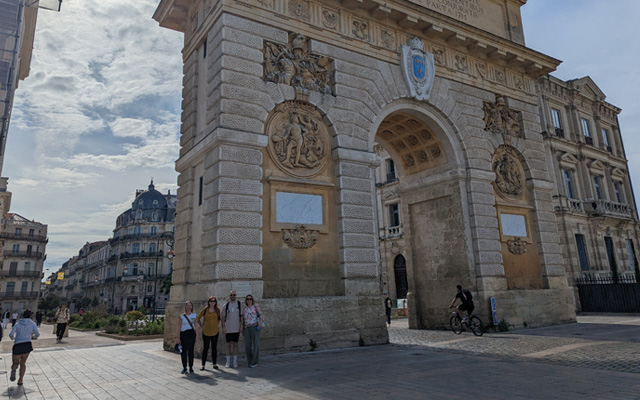
Start at Place de la Comédie, one of Montpellier's most famous squares. From here, your group can explore the Écusson (the historic centre, named after its shield-like shape). This area is mostly pedestrianised, which makes it especially useful for school groups. Students can explore narrow streets, cafe-lined squares, historic buildings and independent shops while continuing to hear and read French all around them.
Depending on your itinerary, you may also see:
- The Opéra Comédie
- The Three Graces Fountain
- The Arc de Triomphe
- The Promenade du Peyrou
- Some of the 200+ hôtels particuliers (beautiful townhouses)
Montpellier works particularly well for older students studying French culture, urban life or the contrast between regional and national identity.
After your guided visit of Montpellier, you'll return to your accommodation in Sète for your evening meal.
This is a good evening to help students reflect on the differences between the two places. Sète feels coastal and local. Montpellier feels urban and youthful. Both reveal something different about life in the South of France.
Day 4 - French Lessons, Treasure Hunt and the Cinema
- Breakfast at your accommodation
- French lessons at a specialist language school
- Free time for lunch
- Take part in a treasure hunt around Sète
- Evening meal at your accommodation
- Cinema trip
The fourth day starts with another morning of French lessons.
By now, students have had several days of repeated exposure to French. This is where confidence often starts to build quickly. They recognise more. They risk more. They rely less on teachers and more on themselves (and that's a real win).
Lunch is another opportunity for students to use French independently.
You could set them a simple challenge:
- Buy something from a market stall
- Ask for directions
- Find out the price of a local speciality
- Read a menu and explain one dish
- Ask a local person what they would recommend visiting in Sète
These small tasks give students a clear purpose. They also help them to see French as a tool, not just a subject.
In the afternoon, take part in a treasure hunt around Sète.
This is a brilliant activity for language learning because it combines movement, observation, problem-solving and communication. Students need to read clues, work as a team and engage with the town around them.
It's also a good way to revisit places they've seen earlier in the trip, helping them connect vocabulary and cultural knowledge with real locations.
For groups with an interest in art and culture, a street art trail around Sète can be a fantastic alternative (or addition). Sète is known for its street art, particularly through the K-Live Festival and the MACO open-air museum. Students can explore murals around the town and discuss themes such as public art, identity, urban spaces and creative expression.
This can work especially well for cross-curricular groups combining French with art, photography or cultural studies.
After dinner, you may choose to take your group to the cinema to watch a French film.
This is a lovely final evening activity. Students have spent several days tuning their ears into French, so hearing the language in a film can feel much less intimidating than it might have been at the start of the trip. You can keep the task simple. Ask students to listen for familiar words, describe one character, or summarise the plot in a few sentences afterwards.
Day 5 - Final French Lessons and Return to the UK
- Breakfast at your accommodation
- French lessons at a specialist language school
- Free afternoon for sightseeing or final souvenir shopping
- Transfer back to Montpellier
- Return flight to the UK
Your final day begins with breakfast and one last session at the language school.
This is a good time for students to consolidate what they've learned, ask final questions and reflect on the progress they've made. A short speaking task can work well here, such as:
- Describing their favourite part of the trip
- Explaining what they found challenging
- Recommending Sète to another student
- Comparing Sète to their hometown
- Talking about what they'd like to do next in French
Give them the chance to hear themselves improve. That's the moment they'll remember.
Depending on flight times, you may have some time for final sightseeing or souvenir shopping before you transfer back to the airport. This is a final chance for students to use their French in a practical way. Buying postcards. Choosing gifts. Asking prices. Saying thank you. Real-life language, right up to the end.
You'll then transfer back to Montpellier Airport (or your chosen departure airport) for your return flight to the UK.
Students return home with more than photos. They come back with stronger listening skills, greater speaking confidence and a clearer sense of why learning French matters.
And you return knowing you gave them that.
Halsbury Team Tips
What can students learn?
A trip to Sète can support language learning in several powerful ways. Students can:
- Build confidence speaking French in real-life situations.
- Improve listening skills through everyday exposure.
- Learn more about regional identity in the South of France.
- Experience French food, markets, transport and family life.
- Compare coastal Sète with urban Montpellier.
- Understand the role of local traditions (such as water jousting).
- Explore culture through street art, music, literature and maritime heritage.
- Develop independence and resilience.
For GCSE and A-Level students, the trip can also support themes such as family life, free time, festivals, food, travel, tourism, regional culture and future aspirations.
Where do groups stay in Sète?
School groups visiting Sète can usually choose between host family accommodation and residence accommodation.
Host family stays are ideal for schools that want a deeper language immersion experience. Students will usually stay in pairs and spend time with their hosts in the evenings, giving them regular opportunities to use French outside the classroom.
This can feel like a big step for some students, but it's often where meaningful progress happens. They realise they can communicate. They realise mistakes are survivable. They realise French belongs outside the textbook.
Residence accommodation is a good choice for groups who prefer to stay together in one place. The beach campus offers a more contained setting, with lessons, meals and group facilities available on site.
This can be particularly useful for younger groups, larger groups or teachers planning their first overseas trip.
Both options work beautifully. The right choice depends on your group.
When is the best time to visit Sète?
Sète works well at several points in the school year.
Spring and early summer are especially appealing for school groups, with pleasant weather and plenty of outdoor learning opportunities. Autumn can also be a good option, particularly for groups wanting a calmer atmosphere.
Sète has a busy cultural calendar, including festivals celebrating the city's maritime history, its seafood, its street art and its music, as well as the famous water jousting events for the Saint-Louis celebrations.
For schools, the best time to visit will depend on your learning objectives, budget, exam timetable and preferred style of trip.
We can help you work through all of that.
Is Sète a good destination for GCSE and A-Level French?
Yes. Sète is an excellent destination for GCSE and A-Level French groups because it combines structured language lessons with real cultural immersion.
GCSE students can practise everyday topics such as food, free time, travel, family life and the local area. A-Level students can explore richer cultural themes, including regional identity, art, music, literature, tourism and the relationship between tradition and modern life.
Sète also gives students a strong sense that France is not one single thing. It has regions, accents, histories, landscapes and local identities. And that's a valuable lesson for any language learner.
What activities can school groups do in Sète?
There are a wide range of activities (depending on your group's interests). Popular options include:
- French lessons
- Guided walking tour of Sète
- Pétanque workshop
- Treasure hunt
- Montpellier excursion
- Street art trail
- Les Halles market visit
- French cinema evening
- Beach activities
- Cookery or baking workshop
- Watersports
- Visit to La Pointe Courte
- Cultural visits linked to Paul Valéry or Georges Brassens
The best itineraries balance learning, culture and breathing space.
Because teachers know the reality: students need structure, but they also need room to absorb what they're experiencing.
How do you get to Sète from the UK?
Most school groups travel to Sète by flying into Montpellier and transferring by coach.
Depending on your departure airports and flight routes, it may also be possible to fly into other airports in the South of France, such as Béziers, Marseille, Carcassonne or Toulouse.
We'll advise you on the most practical route for your group, based on your location, dates, budget and preferred itinerary.
Why plan your trip with Halsbury?
A school trip should feel exciting. It should also feel supported.
That's where we come in.
We'll help you shape the right itinerary, choose the right accommodation, organise your travel and build a trip that supports your learning objectives. We'll guide you through the practical details and help you deal with the questions that always come with taking young people abroad.
Because planning a school trip is a big responsibility.
We're here to make it feel possible.
Start planning your next trip
If you're looking for a destination that combines language lessons, cultural immersion and the unforgettable atmosphere of the Mediterranean, Sète is a brilliant choice.
Students can learn French, use French and live French for a few precious days. And when they return to the classroom, they'll bring that confidence with them.
Ready to explore a tailor-made trip? Request a quote today.

